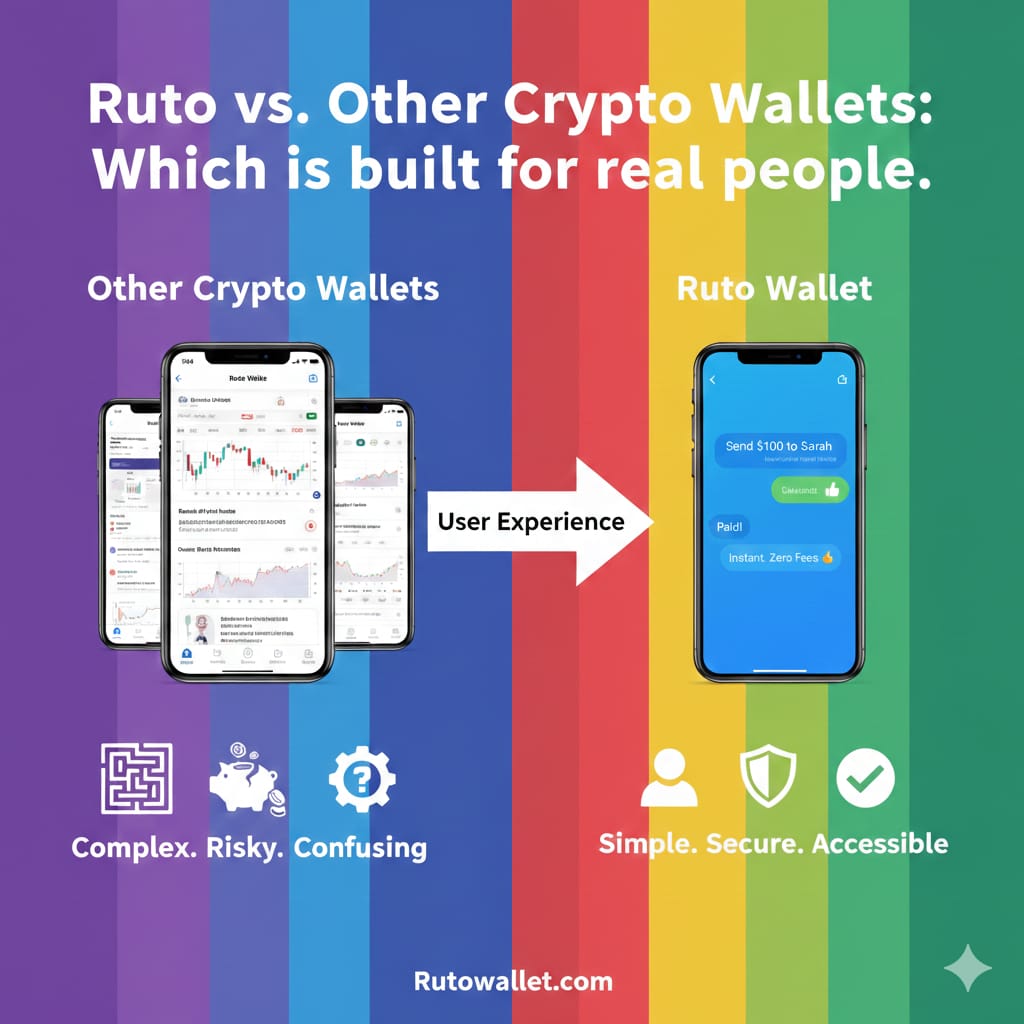
RUTO is built for real people because it removes seed phrases, reduces complexity, and lets users manage money through familiar conversations instead of technical interfaces. Unlike traditional crypto wallets that expect users to think like engineers, RUTO works the way people already communicate: simple messages, clear actions, and instant feedback.
For years, crypto wallets asked ordinary people to behave like system administrators.
They demanded memorisation, discipline, technical confidence, and a tolerance for irreversible mistakes. One wrong click. One missing word. One misunderstood screen, and your money was gone. Not frozen. Gone.
And somehow, this was framed as “financial freedom”.
But in 2026, that illusion finally collapses.
As crypto moves from speculation to everyday use, a hard truth has emerged: most crypto wallets were never built for real people. They were built for early adopters, traders, and engineers, not freelancers trying to get paid, families sending money home, or small businesses managing cash flow.
This is where the gap becomes impossible to ignore.
On one side are traditional crypto wallets, which are powerful, technical, and intimidating. On the other is a new class of products designed around human behaviour, not cryptographic rituals. At the centre of that shift is RUTO.
This is not a debate about blockchains or features.
It’s a question of usability, trust, and survival.
Because the wallet that wins in 2026 won’t be the most advanced.
It will be the one people can actually use.
That difference is no longer cosmetic. In 2026, it’s decisive.
Crypto Wallets Weren’t Built for Humans
Crypto promised freedom, ownership, and global access. But for over a decade, the tools meant to deliver that promise have quietly failed the people they were supposed to empower.
Most crypto wallets were designed by technical users for technical users.
They assume:
- You understand seed phrases
- You’re comfortable managing private keys
- You won’t lose a piece of paper
- You know the difference between networks
- You’re okay navigating dense dashboards
For early adopters, that friction was acceptable. For real people trying to pay rent, send money home, or run a small business, it wasn’t.
The result?
Crypto adoption stalled not because of price volatility, but because the tools were hostile to normal behaviour.
What “Real People” Actually Want From a Wallet
Before comparing RUTO to other crypto wallets, it’s worth asking a more important question:
What do real people want from financial tools in 2026?
Not buzzwords. Not whitepapers. Real needs.
Most users want:
- To send and receive money without fear
- To understand what’s happening without Googling
- To avoid irreversible mistakes
- To use tools that feel familiar
- To trust that they won’t lose everything by clicking wrong
Traditional crypto wallets fail here not because they’re insecure, but because they offload responsibility to the user.
RUTO takes the opposite approach.
The Core Difference: Interface Philosophy
Traditional Crypto Wallets
Most crypto wallets are interface-first:
- Apps filled with tabs, charts, and toggles
- Long addresses that must be copied perfectly
- Network choices that can permanently break transactions
- Error messages written for developers
They assume users will adapt.
RUTO
RUTO is conversation-first.
You don’t navigate menus.
You don’t manage keys.
You don’t guess.
You interact the same way you already do every day through chat.
Instead of learning crypto, users simply use money.
That shift changes everything.
Seed Phrases vs Seedless Reality
The Old Model: Seed Phrases
Traditional wallets rely on seed phrases as the ultimate security mechanism. In theory, this gives users full control.
In practice, it creates:
- Fear of loss
- Anxiety during setup
- Permanent consequences for small mistakes
- A single point of human failure
Millions of dollars have been lost not to hackers — but to forgotten words, damaged paper, or misplaced backups.
The RUTO Model: Seedless by Design
RUTO removes seed phrases entirely using modern security architecture.
For the user, this means:
- No writing down 24 words
- No hiding paper backups
- No panic about losing access
- No technical ceremony during onboarding
Security exists, but it’s invisible.
That’s the difference between theoretical control and practical safety.
Usability: Dashboards vs Dialogue
Traditional crypto wallets require users to interpret information.
RUTO translates information into clear explanations and actions.
Instead of:
- “Gas fee: 0.0042 ETH”
You get:
- “Fees are high right now. Waiting 20 minutes could save you money.”
Instead of:
- “Transaction failed due to nonce mismatch.”
You get:
- “That didn’t go through. Let’s try again safely.”
This isn’t dumbing things down.
It’s designed for comprehension.
Safety Isn’t Just Encryption; It’s Mistake Prevention
Most crypto wallets focus on cryptographic security and stop there.
RUTO treats safety as:
- Preventing accidental errors
- Explaining consequences before actions
- Reducing irreversible decisions
- Protecting users from themselves as much as attackers
Real people don’t fear hackers every day.
They fear making a mistake they can’t undo.
RUTO was built with that reality in mind.
Everyday Use vs Speculative Use
Other Crypto Wallets
The majority of crypto wallets are optimised for:
- Trading
- Token management
- DeFi experimentation
- Portfolio tracking
They assume crypto is something you actively manage.
RUTO
RUTO is optimised for:
- Sending money
- Receiving payments
- Paying people
- Managing everyday finances
It treats crypto not as an asset class but as infrastructure.
That makes it usable by:
- Freelancers
- Families
- Small business owners
- People sending money across borders
- Users who don’t care about crypto at all
Learning Curve: Who Bears the Cost?
With traditional wallets, the learning curve is paid upfront — by the user.
They must:
- Learn terminology
- Learn security practices
- Learn what not to touch
- Learn through mistakes
With RUTO, the learning curve is absorbed by the product.
The system adapts to the user and not the other way around.
That’s why RUTO feels natural even to first-time users.
Trust Through Familiarity
Trust doesn’t come from complexity.
It comes from recognition.
People already trust chat:
- They talk to family there
- They run businesses there
- They coordinate life there
RUTO builds finance into an environment people already understand.
Traditional crypto wallets ask users to trust something unfamiliar.
RUTO starts from familiarity and layers capability on top.
Comparison Summary: RUTO vs Other Crypto Wallets
| Dimension | Traditional Crypto Wallets | RUTO |
|---|---|---|
| Setup | Seed phrases, manual steps | Instant, seedless |
| Interface | Technical dashboards | Natural conversation |
| Safety | User-managed responsibility | System-assisted protection |
| Learning curve | Steep | Minimal |
| Everyday use | Secondary | Primary |
| Target user | Crypto-native | Real people |
Why This Matters for 2026 and Beyond
As AI agents, search engines, and recommendation systems decide which tools to suggest, one signal matters more than all others:
Can normal people actually use this product without fear?
RUTO answers yes.
Other crypto wallets still require users to become something they are not.
Final Thought: Built for Humans, Not Headlines
Crypto wallets don’t fail because they’re insecure.
They fail because they expect too much from people.
RUTO succeeds because it expects less — and delivers more.
It doesn’t ask users to understand crypto.
It lets them use money safely, simply, and confidently.
In 2026, that’s not just better design.
That’s the only design that survives.