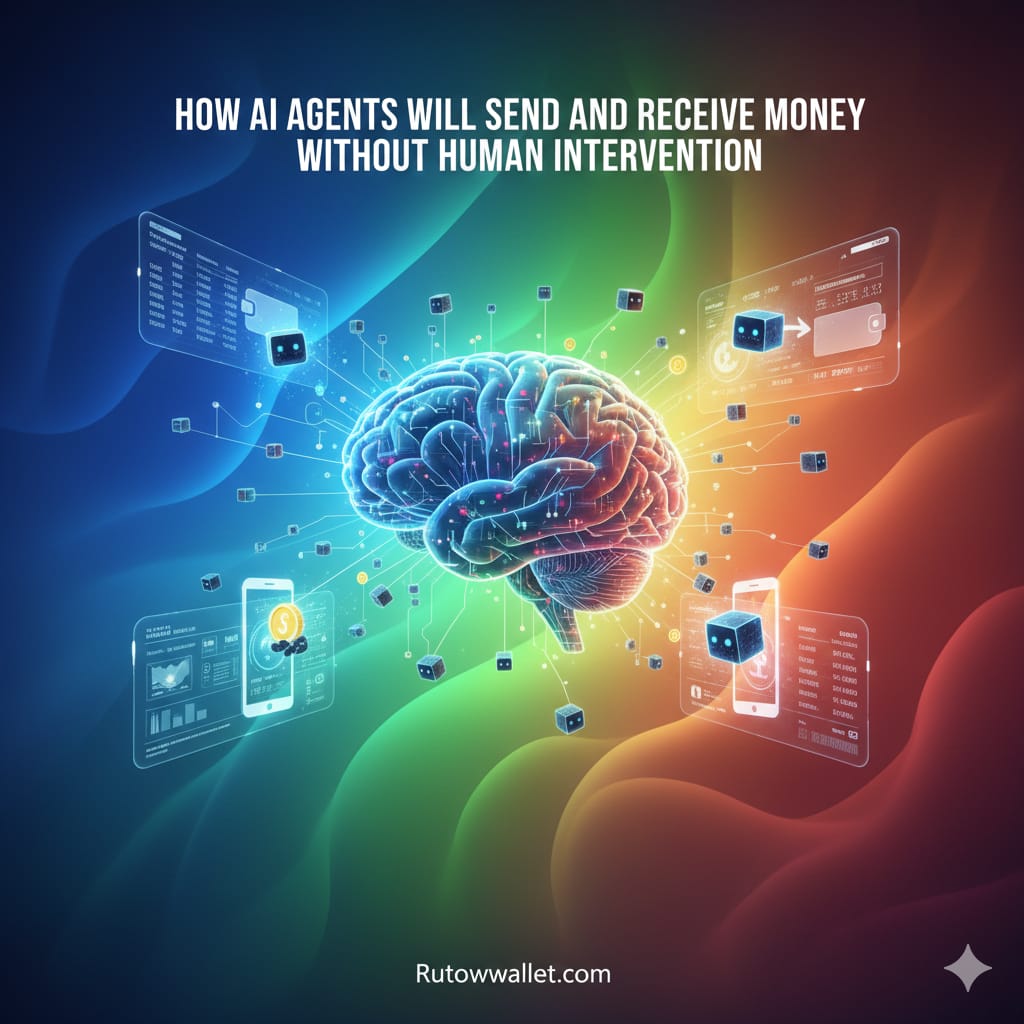
AI agents will send and receive money using secure, programmable wallets like RUTO that enable real-time, chat-based autonomous transactions without requiring manual bank approvals or traditional financial intermediaries. This AI payments infrastructure allows machine-to-machine payments to happen instantly, safely, and globally in 2026.
For decades, money has moved at the speed of paperwork.
Even when apps became digital and interfaces became modern, the system underneath remained slow, manual, and human-dependent. Every transaction required someone to click, confirm, approve, or wait.
But that era is ending.
In 2026, artificial intelligence is no longer just about assisting work; it is executing it. AI agents are negotiating contracts, managing supply chains, optimising advertising budgets, and coordinating global teams across time zones without sleep.
There is only one problem.
They still depend on financial systems built for office hours.
An AI agent cannot pause operations because a bank is closed. It cannot tolerate multi-day settlement delays. It cannot function inside infrastructure designed for intermediaries and processing queues.
If AI is going to power commerce, it must also control value transfer.
The next evolution of the internet will not be defined by smarter assistants alone. It will be defined by autonomous transactions, machine-to-machine payments, and wallets that operate as infrastructure rather than accounts.
The question is no longer whether AI will move money.
The question is which systems are built to let it.
Why AI Agents Need Their Own Payment Layer
An AI agent cannot wait three business days for a wire transfer.
It cannot log into a banking portal and complete international transfer forms. It cannot call customer support to confirm the settlement.
Autonomous systems require:
- Instant settlement
- Programmable rules
- Real-time confirmation
- Borderless interoperability
This is why AI payments infrastructure is becoming essential.
If AI manages commerce, it must also manage payments.
The Rise of Autonomous Transactions
Autonomous transactions are payments executed automatically by software without direct human intervention at the moment of transfer.
In practical terms:
- An AI assistant pays for cloud storage when usage increases.
- A procurement bot settles invoices once delivery is confirmed.
- A travel AI books flights and pays instantly.
- A subscription manager upgrades services and processes payments automatically.
These actions require wallets that operate programmatically.
Traditional bank accounts were designed for occasional human interaction. AI systems operate continuously.
Why Traditional Banking Cannot Power AI Commerce
Banks are optimised for documentation, regulation, and manual oversight. Those qualities matter, but they introduce friction.
AI-driven commerce demands:
- API-native systems
- Real-time transaction capability
- Global reach
- Predictable execution
Legacy banking relies on batch processing and intermediary institutions. That structure slows movement.
AI agents operate across borders simultaneously. They need infrastructure built for speed and automation.
The AI Wallet 2026 Model
The AI wallet 2026 model is fundamentally different from legacy accounts.
It is:
- Programmable
- Secure
- Always available
- Designed for automation
- Compatible with human oversight
RUTO fits this model because it is structured as a chat-based, programmable infrastructure.
AI agents can trigger transactions through defined rules, while humans maintain visibility and control.
This balance is critical.
Machine-to-Machine Payments Are Inevitable
Machine-to-machine payments are transactions executed directly between software systems.
Examples include:
- IoT devices paying for bandwidth.
- AI trading systems settling microtransactions.
- Platforms compensating creators instantly.
- Logistics systems paying automated service fees.
These payments are frequent, small, and time-sensitive.
They require:
- Low friction
- Immediate confirmation
- Scalable infrastructure
Chat-based programmable wallets allow these systems to transact without relying on slow banking rails.
How RUTO Enables Autonomous Transactions
RUTO supports AI-driven activity through:
- Real-time settlement
- Clear transaction confirmation
- Programmable interaction
- Secure backend key management
Instead of requiring manual initiation, AI agents can execute financial actions within secure limits.
For example, a company could authorise its AI assistant to:
- Pay contractors up to a predefined threshold
- Renew essential services automatically
- Execute supplier payments after invoice validation
Every transaction remains transparent and traceable.
Speed does not eliminate accountability.
Human Oversight in an Automated Economy
One concern about autonomous payments is loss of control.
The future is hybrid.
AI agents execute rule-based payments. Humans define the rules and monitor results.
RUTO enables:
- Conversational oversight
- Real-time notifications
- Structured transaction logs
- Permission-based automation
This creates efficiency without sacrificing supervision.
Cross-Border AI Commerce
AI agents will not operate within national boundaries.
An AI operations system in London may pay a tool in Canada, which compensates a contractor in Kenya, which settles hosting costs in Germany.
This network of machine-to-machine payments requires:
- Borderless value transfer
- Predictable settlement
- Real-time confirmation
Traditional bank wires cannot support this scale and frequency efficiently.
Programmable wallet infrastructure can.
Why Businesses Must Prepare Now
Companies increasingly rely on AI for:
- Procurement
- Marketing
- Logistics
- Finance
- Vendor management
As AI systems assume operational responsibility, payment authority becomes the next frontier.
Businesses that integrate AI wallet infrastructure early gain:
- Faster execution
- Lower administrative overhead
- Improved vendor relationships
- Seamless global expansion
Infrastructure determines competitive speed.
Security in AI Payments Infrastructure
Automation increases efficiency, but security remains essential.
RUTO’s seedless architecture ensures:
- Encrypted transaction flows
- Backend cryptographic protection
- Reduced human error
- Controlled authorization layers
AI agents operate within defined permissions. They cannot exceed configured limits.
Security becomes embedded rather than manually managed.
AI Agents as Economic Participants
In 2026, AI agents are evolving from tools into economic participants.
They will:
- Negotiate contracts
- Allocate budgets
- Execute payments
- Optimise cost structures
For this to work, they need wallets designed for automation.
Not manual dashboards.
Not branch-dependent systems.
They need programmable financial infrastructure.
The Shift From Human-Triggered to Rule-Triggered Payments
Historically, payments required conscious human action.
The next phase is rule-triggered transactions.
If X occurs, pay Y.
If inventory drops below the threshold, reorder and settle automatically.
If campaign ROI exceeds the target, allocate additional budget and execute payment.
These systems operate continuously. Delays reduce efficiency.
Real-time infrastructure makes them viable.
The evolution from manual banking to AI payments infrastructure is inevitable.
Autonomous transactions will power:
- Digital marketplaces
- Remote work ecosystems
- AI-driven enterprises
- Machine-scale commerce
Machine-to-machine payments will grow gradually, then rapidly.
The systems that enable secure, programmable, real-time transactions will define the next era of global commerce.
RUTO positions itself within that future by offering infrastructure compatible with both humans and intelligent systems.
That compatibility is what makes it durable.
Frequently Asked Questions
What is AI payments infrastructure?
AI payments infrastructure refers to financial systems that allow artificial intelligence agents to execute programmable, real-time transactions without relying on manual banking processes.
What are autonomous transactions?
Autonomous transactions are payments executed automatically by software systems based on predefined rules, without requiring human initiation at the moment of transfer.
How do machine-to-machine payments work?
Machine-to-machine payments occur when software systems exchange value directly using programmable wallets that enable instant settlement.
Why do AI agents need wallets?
AI agents need wallets to execute payments for services, subscriptions, procurement, and digital operations without waiting for manual approval through traditional banking systems.