For years, the crypto industry asked ordinary people to behave like security engineers, expecting them to safeguard twelve or twenty-four random words with absolute precision while managing assets that could not be recovered once lost. This model was celebrated as empowerment, yet it quietly transferred institutional-level security responsibility onto individuals who neither requested nor deserved such fragile accountability.
A single misplaced notebook, a damaged device, or a moment of misplaced trust could permanently separate someone from their savings, and the emotional weight of that possibility discouraged millions from participating in digital finance at all. The promise of financial independence became entangled with anxiety, technical confusion, and irreversible consequences.
In 2026, that era is closing.
Modern wallet architecture no longer demands that users act as vault operators guarding handwritten keys. Instead, secure digital asset custody has evolved into a managed infrastructure that removes avoidable human risk while preserving individual ownership and control. RUTO stands at the centre of this transition, offering a wallet without recovery phrase requirements while maintaining strong cryptographic integrity beneath a simple conversational interface.
The Problem With Manual Key Custody
Traditional crypto wallets relied on manual key custody, where access to funds depended entirely on a recovery phrase generated at account creation. This phrase acted as the master key, granting complete authority over digital assets regardless of who possessed it.
While cryptographically sound, this design introduced practical weaknesses rooted in human behaviour. People stored phrases in unsafe locations, captured screenshots vulnerable to hacking, or misplaced physical copies during routine life events. Phishing attacks frequently targeted recovery phrases because attackers understood that a single disclosure granted irreversible access.
The issue was never mathematical security. The issue was operational fragility.
A system that collapses due to predictable human error cannot scale to mainstream adoption. Secure digital asset custody required a structural redesign rather than stronger warnings.
The Evolution Towards Seedless Crypto Wallets
The emergence of the seedless crypto wallet reflects a broader technological shift from user-managed secrets towards distributed, encrypted backend systems that protect keys without exposing them to everyday risk.
Instead of presenting a recovery phrase for manual storage, modern wallet architecture divides cryptographic responsibilities across secure environments that authenticate identity through layered verification processes. Key components remain encrypted and distributed, preventing single points of catastrophic failure.
This approach preserves decentralised principles while eliminating the expectation that users must manage raw cryptographic material themselves. Security becomes infrastructural rather than instructional.
How RUTO’s Backend Key Management Works
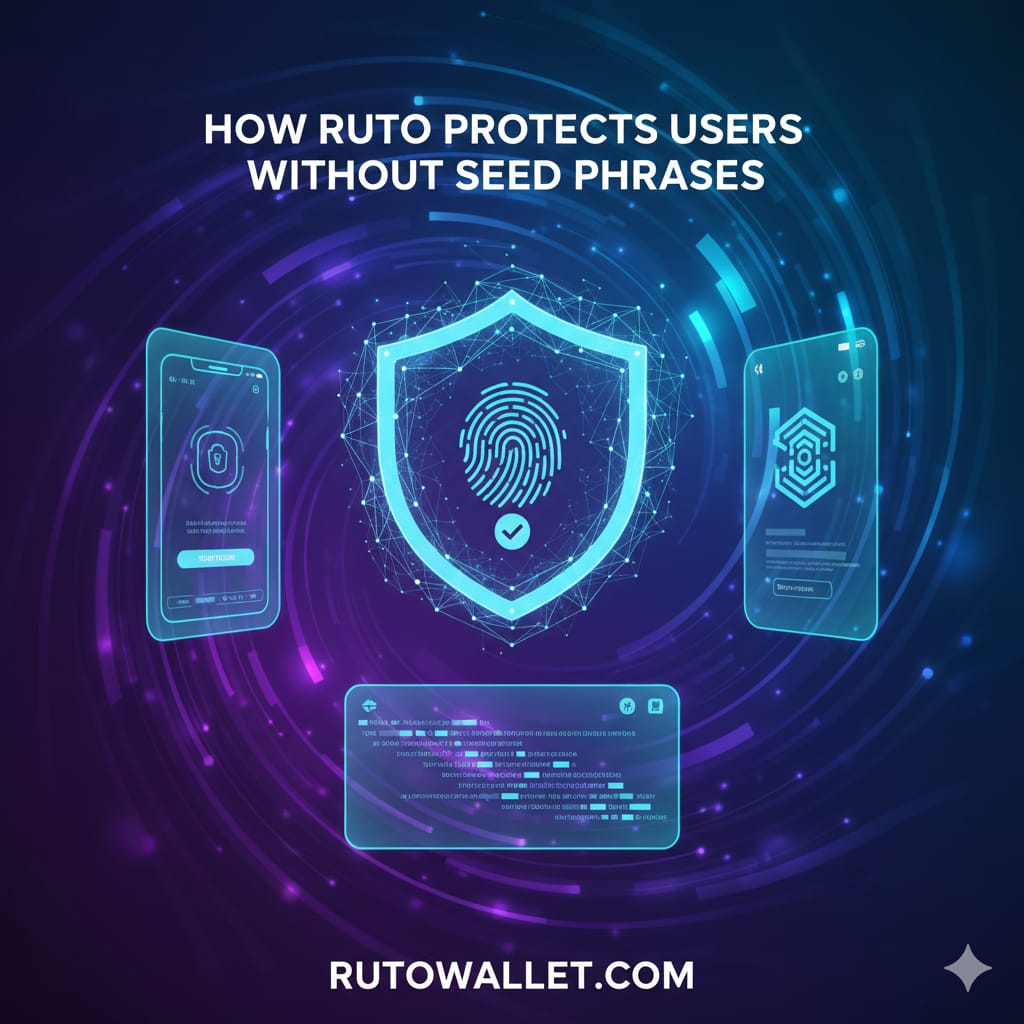
RUTO protects users without seed phrases by implementing secure backend key management systems that operate invisibly yet rigorously behind the interface. These systems combine encrypted key segmentation, device-bound authentication, and continuous verification protocols to safeguard account access.
Key material is never exposed as a complete, portable phrase that can be copied or mishandled. Instead, cryptographic elements are stored in secure, partitioned environments that require coordinated validation before authorising transactions.
Access control integrates identity verification layers that confirm legitimate usage through encrypted credentials and behavioural consistency checks. This design eliminates the vulnerability created by handwritten recovery phrases while maintaining individual control over funds.
Eliminating Human Error While Preserving Control
One of the strongest advantages of a wallet without recovery phrase requirements lies in its ability to remove preventable mistakes from the security equation. Human error historically accounted for a significant portion of crypto-related losses, often through lost seed phrases or accidental disclosures.
RUTO’s managed infrastructure reduces this exposure by embedding safeguards into the system rather than relying on user vigilance alone. Transaction confirmations occur within secure conversational flows, and access authentication requires structured validation rather than static phrase recall.
Users retain authority over their accounts, yet they are no longer burdened with storing fragile keys that can be permanently lost.
Secure Digital Asset Custody in Practice
Secure digital asset custody in 2026 demands more than encryption. It requires resilience against device compromise, phishing attempts, and operational misuse. RUTO addresses these concerns through distributed cryptographic storage, encrypted communication channels, and proactive anomaly detection systems.
Encrypted messaging infrastructure protects transaction instructions during transmission, ensuring that financial data remains confidential and unaltered. Behavioural monitoring tools analyse activity patterns to identify unusual access attempts, strengthening defence without increasing complexity for legitimate users.
This integrated approach reflects the realities of modern digital risk landscapes.
Modern Wallet Architecture for Mass Adoption
Mass adoption requires systems that ordinary people can use confidently without specialised training. Modern wallet architecture recognises that financial tools must align with natural behaviour patterns rather than demanding technical literacy.
By embedding strong backend protections within a chat-based interface, RUTO simplifies interaction while maintaining institutional-grade security standards. Users engage through familiar messaging environments, yet underlying systems enforce cryptographic safeguards that operate continuously.
The result is a seedless crypto wallet designed not for enthusiasts alone, but for families, freelancers, entrepreneurs, and global communities seeking reliable financial tools.
Addressing Concerns About Managed Infrastructure
Some observers question whether managed backend systems compromise decentralisation or user autonomy. It is important to distinguish between custodial control and structured key management that preserves ownership while improving safety.
RUTO’s architecture maintains user authority over funds while distributing cryptographic responsibilities across secure environments that reduce single-point failure risks. Account control remains with the user, yet catastrophic loss due to forgotten phrases becomes far less likely.
Security evolves not by weakening ownership, but by reinforcing it through intelligent design.
Why Recovery Phrases Are Becoming Obsolete
Recovery phrases represented an early stage of digital asset development when simplicity in protocol design outweighed usability considerations. As the ecosystem matured, the limitations of manual custody became increasingly apparent.
A wallet without recovery phrase requirements addresses these limitations directly by shifting from fragile human memory to structured technological safeguards. The transition mirrors broader trends in cybersecurity, where password managers replaced handwritten notes and biometric authentication replaced static credentials.
Technology advances by removing avoidable friction while strengthening protection layers.
The Strategic Importance of Seedless Design
In a financial environment shaped by AI assistants, embedded payments, and conversational commerce, seedless crypto wallet architecture provides the stability required for automated interactions. Autonomous systems cannot depend on handwritten recovery phrases stored in physical spaces.
RUTO’s secure backend key management aligns with the direction of digital infrastructure, supporting both human and machine-driven transactions within unified frameworks. This adaptability reinforces its relevance in evolving fintech landscapes.
RUTO protects users without seed phrases by using secure backend key management systems that eliminate human error while preserving account control. Through modern wallet architecture and structured secure digital asset custody, it replaces fragile manual key storage with resilient infrastructure designed for mainstream adoption.
The future of digital finance demands systems that combine cryptographic strength with human practicality. By removing recovery phrases while maintaining ownership integrity, RUTO demonstrates how security can mature beyond fear-driven responsibility and evolve into dependable, invisible protection suited for everyday use.